
Skip to content

How it works

Strategic decisions are made in the fog.

Andy Grove’s definition: a strategic decision is one made under uncertainty about both the inputs and the outcome. Decisions made with full data are tactical. By the time the data is in, the window has closed. The job isn’t to wait for certainty. It’s to weigh likelihoods and consequences honestly while the window is still open.

Forebold is the board-grade AI Advisor built around that reality. Five steps, run end-to-end, that turn the vague concern in your head into a decision-ready brief, with assumptions named, ranges quantified honestly, and the toughest questions answered before the room asks them.

The mechanism

Five steps. From the hard question to the decision.

You bring the context. The workflow brings structure, rigour, and the questions a tough room would ask first.

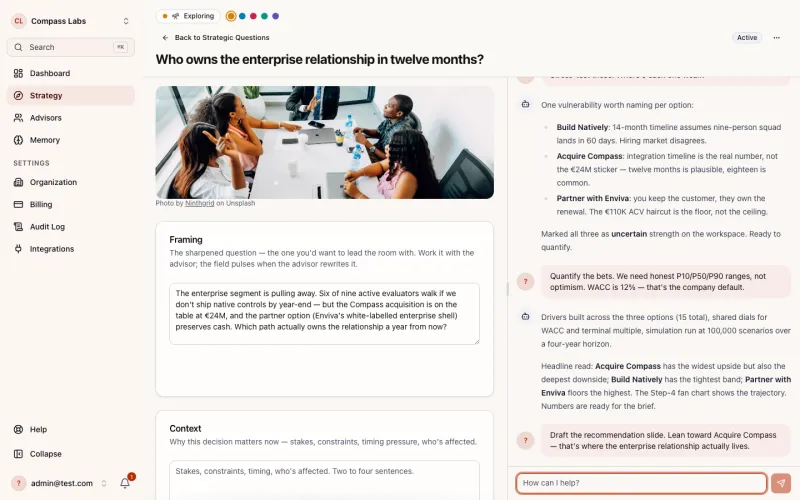
  1. Step 01 · Exploring

    Name the Elephant

    The vague concern in your head becomes a debatable question. Sharp enough to take a position on, narrow enough that two reasonable people could disagree.

    You walk away with

    A sharpened framing + a context paragraph the team can argue with.

    Step 1 workspace — Framing field, context paragraph, and the Exploring-mode advisor pane.
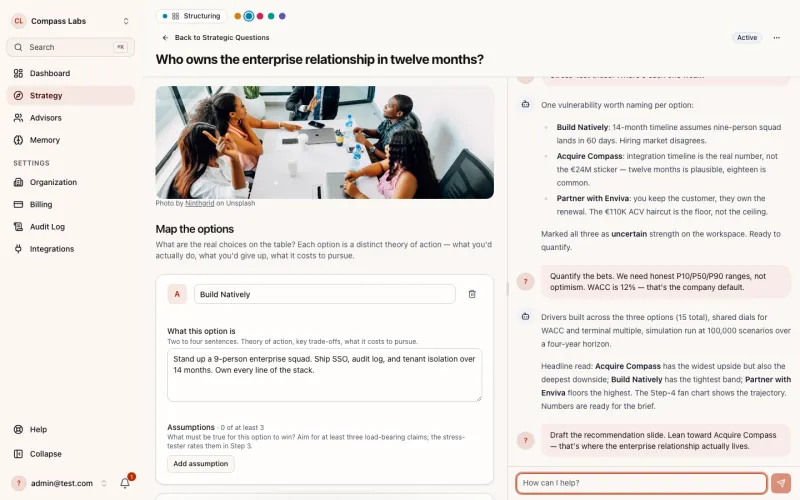
  2. Step 02 · Structuring

    Map the Options

    Two to four real options on the table, distinct enough to be a real choice, each with the assumptions that have to be true for it to win.

    You walk away with

    2–4 distinct options, each with key assumptions made explicit.

    Step 2 workspace — three option cards with their headline assumptions and the Structuring-mode advisor.
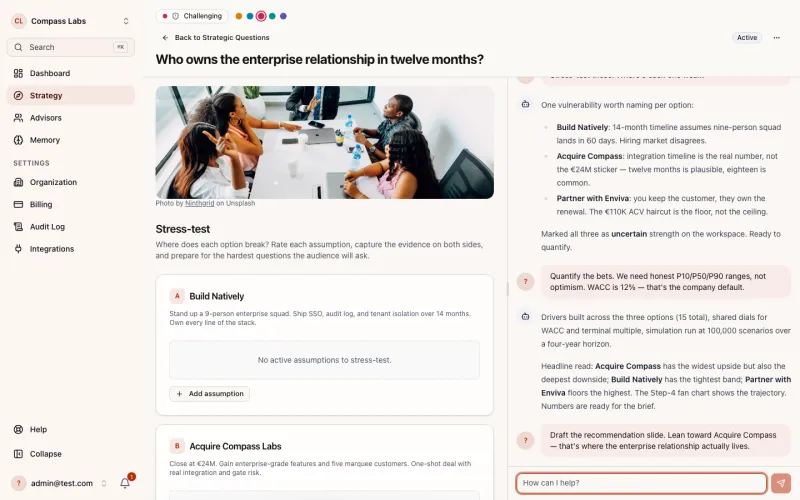
  3. Step 03 · Challenging

    Stress-Test

    Every assumption gets a strength rating and structured evidence. The advisor argues the other side. The questions a tough room would ask are surfaced before the room asks them.

    You walk away with

    Assumption strengths, evidence for and against, and the questions you'd otherwise be blindsided by.

    Step 3 workspace — assumption rows with strength sliders, evidence_for and evidence_against panels, and the Challenging-mode advisor.
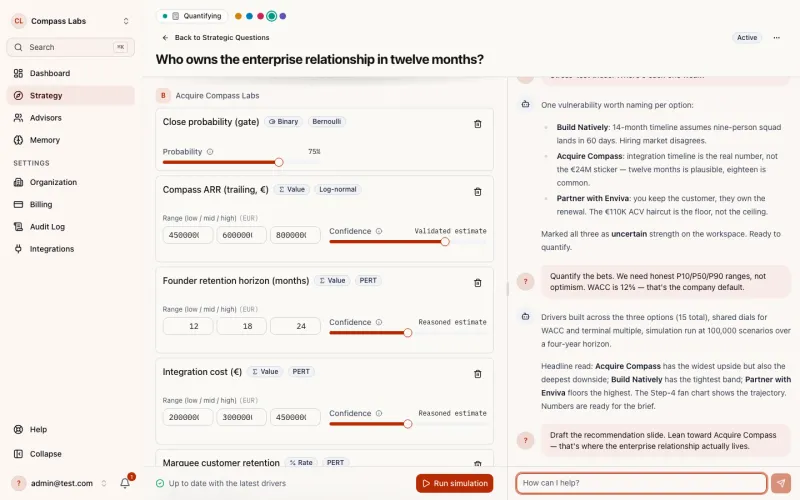
  4. Step 04 · Quantifying

    Simulate

    Each option's drivers run through 100,000 Monte Carlo scenarios. You see the shape of the bet, in honest Upside / Median / Downside ranges, with the assumptions that swing the outcome ranked by impact.

    You walk away with

    NPV ranges per option, a 'what moves the numbers' panel, and a fan chart trajectory.

    Step 4 workspace — driver table with the five-stop confidence slider, range distributions, and the Quantifying-mode advisor.
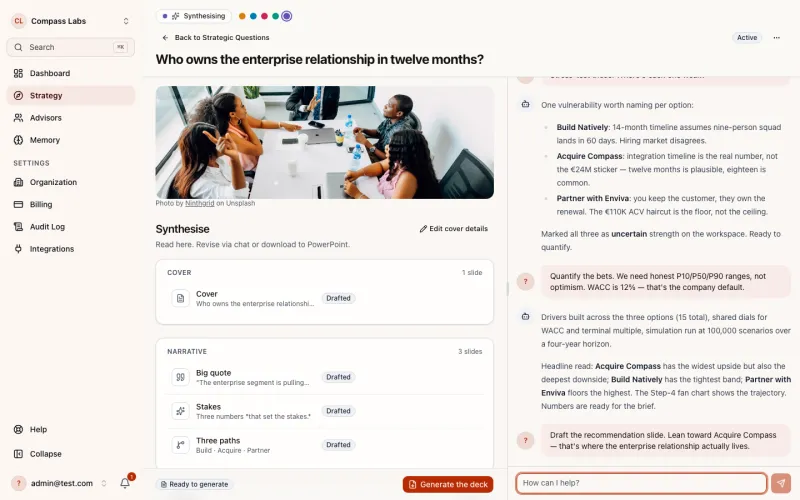
  5. Step 05 · Synthesising

    Brief

    The whole arc collapses into a twelve-slide deck: stakes, three deep-dives, ranges, drivers, recommendation, risks, assumptions appendix. Editable, exportable, decision-ready.

    You walk away with

    Decision-ready strategic brief (PPTX, ~12 slides) you can present as-is.

    Step 5 workspace — slide outline, render-and-download bar, and the Synthesising-mode advisor.
First pass
30 minutes

A structured first cut: question, options, ranges, the shape of the bet, with advisor-benchmarked values.

Defensible brief
Days

Polished slide by slide, with your evidence, your numbers, and assumptions you would defend in the room.

Cadence
Per question

Available every time the hard question lands. Not once a quarter, not when the calendar allows.

Step 4, lived

Two views of the same simulation.

Each option's business case runs through 100,000 Monte Carlo scenarios. The Trajectory view shows year-by-year drift and when the bet pays off; the Distribution view shows the spread of where the option lands at the end of the horizon. Same numbers, two lenses. Toggle below.

The Trajectory's Median crossing zero is the year the middle scenario clears breakeven; the band's widening over time tells you how far scenarios diverge as the bet compounds. The Distribution's tail tells you what the worst-case actually looks like, and how often. Both are produced by the same engine that ships the brief, so the workspace and the deck speak with one voice.

Why it works

Map the fog. Make the bet.

The uncertainty doesn’t go away. That’s the wrong target. The job is to see it clearly: where it sits, how wide it is, what assumption swings it most. Then make the call with the room behind you.

Why ranges, not point estimates

A single number for a future revenue, churn, or integration timeline lies about what the model knows. The simulation produces a Downside (the value 10% of scenarios land below), a Median (the middle scenario), and an Upside (the value 10% land above). The recommendation rides on the shape of those ranges, not on a fabricated point. Statistical names: P10, P50, P90.

The five-stop confidence scale

Every driver is labelled with the strength of the evidence behind it: Measured (your actuals), Validated estimate (triangulated), Reasoned estimate (built from benchmarks), Educated guess (informed intuition), or Placeholder (a stand-in). Same vocabulary in the slider, in the advisor's recommendations, and on the brief — so what you, the team, and the room are reading from is one thing.

The Hubbard floor

Decades of calibration research — Russo and Schoemaker, Hubbard, Lichtenstein and Fischhoff, Tetlock — converge on the same finding: experienced executives' 90% intervals contain the truth 30–50% of the time. The engine compensates by widening the simulated band as confidence drops; at Placeholder it widens about three-fold. Physical bounds (a probability between 0 and 1, a fixed contract length) are honoured untouched. It never narrows your range.

Five-stop confidence scale Engine widening factor · lower confidence widens the band
Measured
exact
Our own actuals.
Validated estimate
+12%
Triangulated across multiple sources.
Reasoned estimate
+50%
Built from benchmarks or first-principles modeling.
Educated guess
≈ ×2
Informed intuition, no structured method.
Placeholder
≈ ×3
A stand-in to be replaced before relying on it.

For the full walkthrough, see Setting honest confidence and How the simulation engine works in the help center.

Bring it to your next hard question

See the workflow against a real decision.

A founding-partner pilot. Two cycles. Bring a question that matters; we'll run it end-to-end with you.

Not ready yet?

Stay in the loop. I only write when there is something worth reading.